Coastal Carbon Capture System
Clima Tree
A modular photobioreactor engineered to remove CO2 in coastal and industrial environments. Clima Tree combines optimized microalgae, mineral-assisted capture, and real-time monitoring in a deployment-ready system for ports, coastal plants, and industrial sites.
Carbon Capture, Engineered for the Coast
Clima Tree is built for organizations that need visible, measurable carbon capture without forcing a conventional solvent-capture footprint into a coastal or industrial site. It turns biological capture into a deployable operating system: reactor columns, monitored intake, mineral-assisted absorption, and live performance data in one modular unit.
For operators, the value is straightforward. Clima Tree captures CO2 continuously, works in harsh Gulf conditions, and produces operational data that can feed reporting, verification, and project decision-making. It is designed for ports, coastal facilities, desalination-linked environments, and sites where marine conditions challenge conventional equipment.
The system has been developed around Gulf deployment realities: heat, salinity, humidity, and airborne salt. That is what makes it feel like a field-ready product rather than a lab concept.
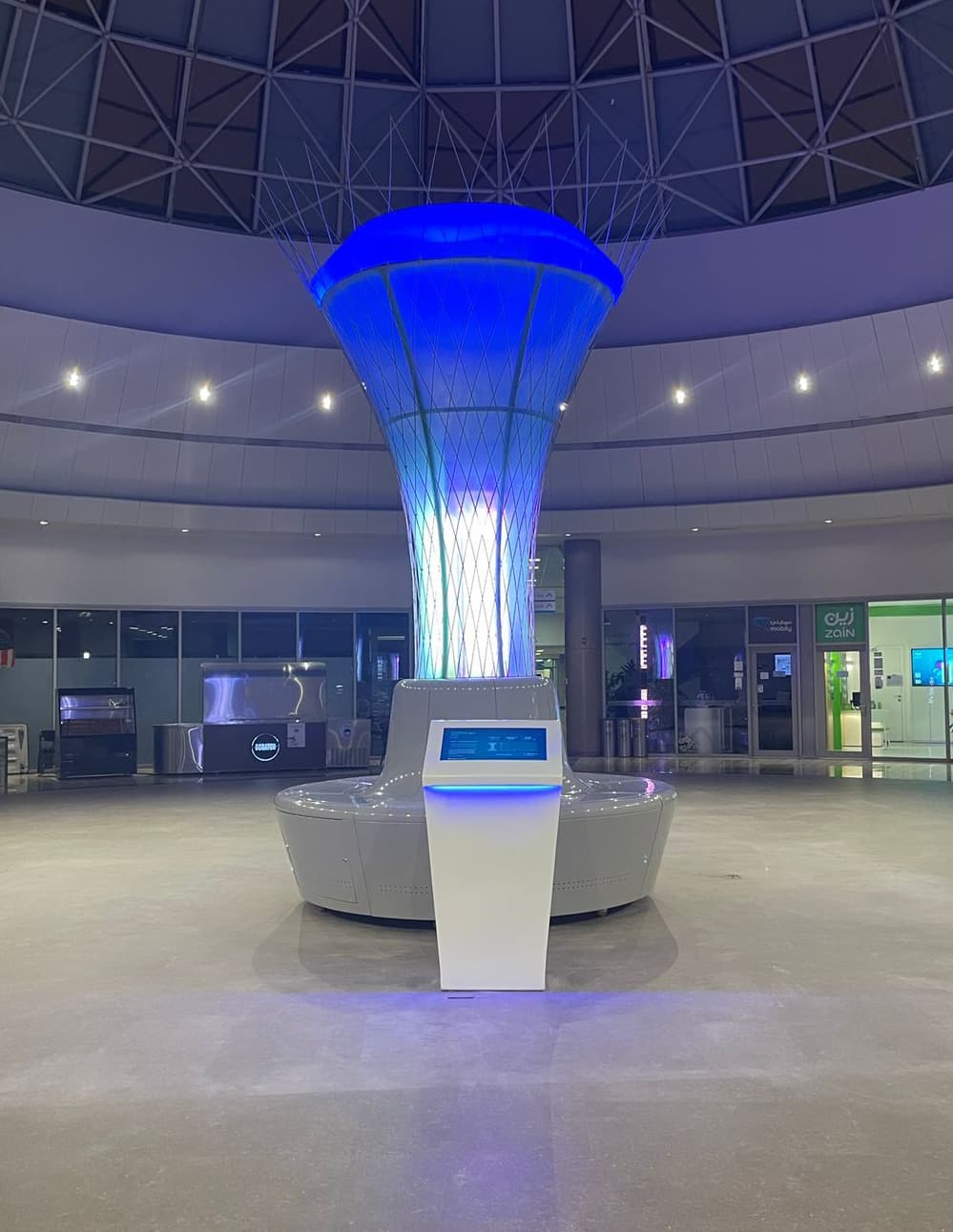
Clima Tree in the field
A deployed photobioreactor system designed for coastal and industrial operating conditions.
How Climatree Works
CO2 Intake
Ambient or point-source CO2 is directed into the reactor through intake manifolds. The system processes atmospheric air, HVAC exhaust, desalination plant off-gas, or concentrated industrial flue gas, adapting intake rates to match source concentration.
Algae Photosynthesis
Optimized microalgae strains circulate through illuminated reactor columns, absorbing CO2 through photosynthesis and converting it into organic biomass. Light can be natural sunlight at coastal installations or LED-supplemented for indoor deployments.
Mineral Absorption
A parallel mineral carbonation pathway captures additional CO2 through reaction with alkaline mineral substrates, forming stable carbonate compounds that permanently sequester carbon in solid form suitable for reef and marine construction aggregate.
Biomass Harvesting
Mature algae biomass is continuously harvested from the reactor loop, maintaining optimal cell density for maximum capture efficiency. Harvested biomass is processed for downstream marine and industrial applications.
Carbon Conversion
Harvested biomass converts into saleable products: aquaculture feed supplements, biofertilizer for coastal agriculture, precursors for biocrude fuel, or dried biomass for industrial use.
Monitoring & Verification
Marine-grade integrated sensors continuously measure CO2 absorption rates, biomass production, and system performance. All data feeds into our dMRV platform for real-time reporting and third-party verification.
Performance Snapshot
Metrics that make the offer tangible
Algal Strains Developed
Continuous Carbon Capture
Patents Filed
Active Deployments
Technical Specifications
Active Deployments
Outdoor coastal deployments across multiple industrial facilities in Saudi Arabia. Clima Tree units operating in continuous carbon capture mode, proven in extreme Gulf summer conditions exceeding 50 degrees Celsius with salt-laden coastal air.
Indoor installations within commercial buildings in Saudi Arabia, proving the viability of Clima Tree for building-integrated carbon capture. Units capture CO2 from HVAC exhaust while serving as architectural features.
Modular multi-unit deployments at Gulf port facilities, processing emissions from port operations and adjacent industrial zones. Installations feed carbonation by-products into artificial reef construction programmes.
Why Climatree
Measurable Carbon Reduction
Every gram of CO2 captured is tracked by marine-grade sensors and verified through our dMRV platform. Auditable data, not estimates.
Revenue from Carbon Products
Captured CO2 converts into saleable products: biomass, fertilizer, biocrude precursors, and carbonate aggregate for reef construction.
Modular Scalability
Start with a single demonstration unit and scale to a full array. Each module operates independently while feeding into a unified monitoring system.
Coastal and Indoor Flexibility
Whether deployed at a port facility, on a coastal industrial site, integrated into a building lobby, or adjacent to a desalination plant -- Clima Tree adapts.
Minimal Energy Input
Biological carbon capture through photosynthesis requires a fraction of the energy consumed by chemical solvent systems. The Gulf sun does the heavy lifting.
Gulf-Proven Technology
Tested and deployed in the Arabian Gulf's most demanding coastal conditions. Our 32 algal strains thrive in high-temperature, high-salinity, high-humidity environments.
Applications
Port Facilities & Maritime Hubs
Capture CO2 from port operations, vessel emissions at berth, and adjacent industrial zones. Ideal for green port certifications and maritime decarbonization targets.
Coastal Industrial Plants
Process flue gas from power generation, desalination, and petrochemical facilities located along the coastline. Integration with existing exhaust infrastructure.
Offshore Platform Support Bases
Deployable at onshore support bases for offshore oil and gas operations, capturing emissions from logistics, maintenance, and crew support facilities.
Commercial Buildings
Building-integrated carbon capture via HVAC exhaust processing, serving as both a sustainability asset and architectural feature for coastal developments.
Desalination Plants
Process CO2 from desalination energy generation while algae systems benefit from controlled saline water access for cultivation medium.
Marine Research Centres
Demonstration installations for marine research institutions, providing live data for academic programmes while generating real carbon capture outcomes.
Deploy Clima Tree at Your Coastal Facility
From site assessment to installation and ongoing monitoring, our engineering team delivers a complete Clima Tree deployment tailored to your marine or industrial requirements. Contact us to discuss specifications, capacity planning, and project timelines.